
How a Starchy Food Can Become a Superfood: The Science of Resistant Starch
I have always been fascinated by the tiny transformations that happen in our kitchens. Dough rising, milk fermenting, lentils softening into a dal, osmotic magic with the salt. But recently, a discovery has completely changed the way I look at carbs.
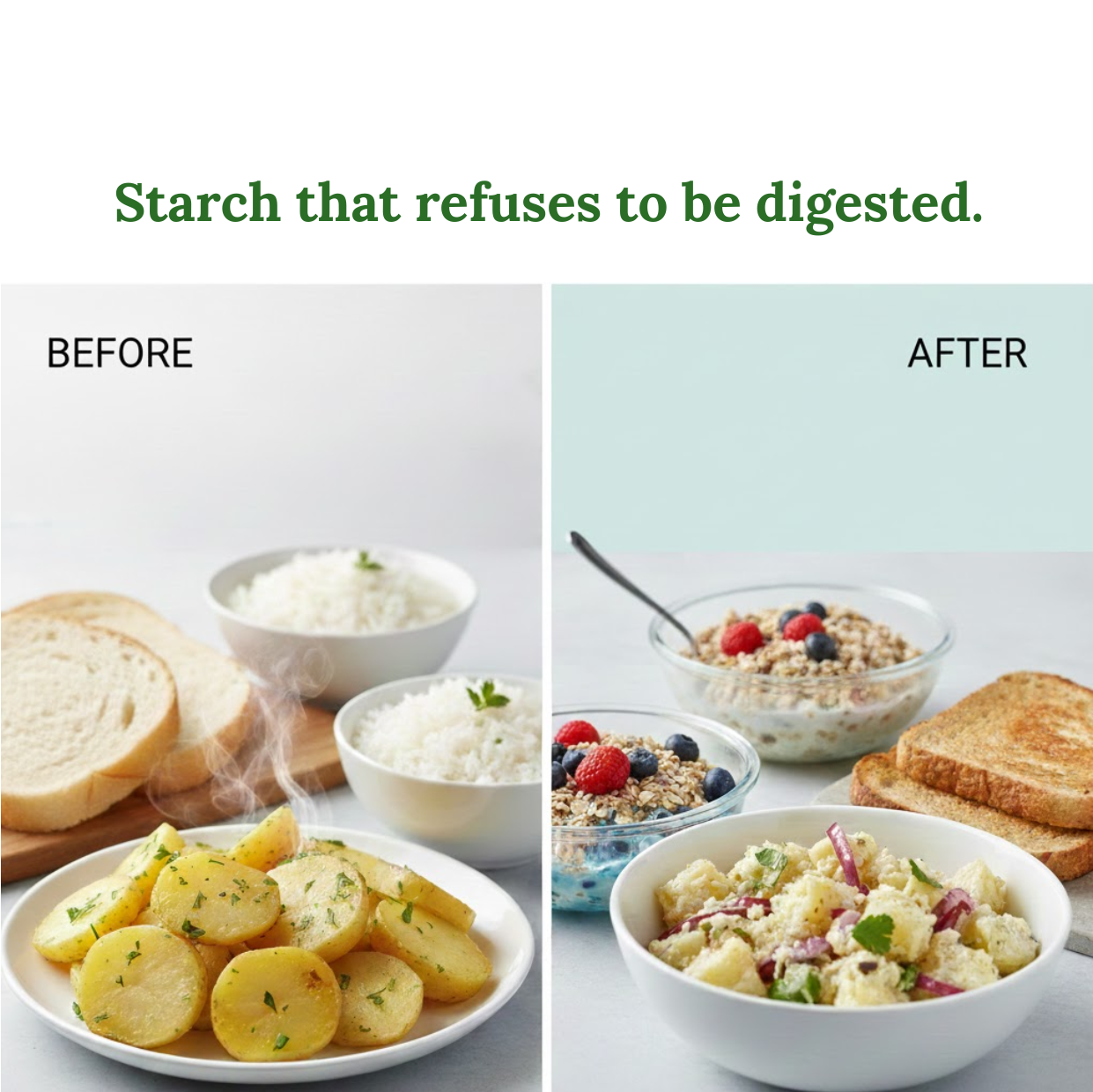
Starch that refuses to be digested.
Yes, rice, potatoes, pasta, even dal can quietly change their chemistry in a way that your body can’t fully break them down. They stop behaving like regular carbs and start acting like gut-friendly fibre. All it takes?
A pot, a fridge, and a little bit of patience.
The Carb Hack No One Told Us About
For years, carbs have been painted as the villains of metabolism, especially for anyone dealing with weight, insulin resistance, or high blood sugar. But here’s the twist. Not all carbs behave the same way. In fact, some of them can be trained to behave better.
Cook your rice, cool it for 12 hours, reheat it and suddenly almost half of its starch becomes resistant, meaning your blood sugar barely reacts to it.
Add a spoon of ghee to your dal and your glucose spike softens even more.
This is not magic, and it’s definitely not a trend.
It’s chemistry. It is one of the most useful food tricks we’ve overlooked.
First, What Is Resistant Starch?
Starch has two parts:
- Amylose (straight chain)
- Amylopectin (branched chain)
When cooked, most starch becomes easy to digest. The body breaks it quickly, glucose rises, insulin rises. But when certain starches are cooled, part of them undergo a major transformation called retrogradation.
This forms Resistant Starch Type 3, which behaves more like fiber than carbohydrate. Multiple studies have shown that when rice is cooked, cooled and reheated, its digestible starch drops significantly by up to 40-50 percent. Cooling forces amylose chains to rearrange into a structure that digestive enzymes can not break down easily.
This means:
- It resists digestion
- It passes through the small intestine undigested
- It feeds gut bacteria
- It reduces glucose spikes
- Better satiety
- More stable energy
For people with insulin resistance, PCOS, diabetes or anyone who is trying to reduce weight, this is a powerful hack.
But Does Reheating Reverse the Benefit?
No, it doesn’t. Once resistant starch is formed during the cooling stage, reheating does not convert it back into regular starch.
So you can enjoy:
- reheated rice
- reheated potatoes
- reheated dal-chawal
- leftover khichdi
- even cold rotis
with lower glucose spikes than freshly cooked versions.
What Foods Form Resistant Starch Easily?
- Rice – one of the best candidates
- Potatoes
- Sweet potatoes
- Pasta
- Oats (especially overnight oats)
- Millets
- Dal (cooked → cooled → reheated dal has more RS)
Even your leftover aloo paratha has more resistant starch than freshly made ones.
What Does Resistant Starch Actually Do in Your Body?
Reduces blood sugar spikes
20–50% depending on food. By slowing digestion and reducing available glucose.
Increases GLP-1 hormone
Helps with appetite regulation and improved insulin sensitivity.
Feeds good gut bacteria
Especially Bifidobacteria, critical for immunity and inflammation control.
Produces butyrate
A short-chain fatty acid that heals the gut lining, reduces inflammation and supports weight management
Enhances satiety
You stay full longer, reduced food cravings, snack less, steadier energy.
Conclusion
At the end of the day, these are not hacks or trends, they are simple shifts rooted in real food chemistry and how the human body works. Resistant starch, cooling-and-reheating, none of these require fancy diets or giving up the foods you love. They are tiny changes that make your regular meals behave better inside your body. Once you start noticing the difference, steadier energy, fewer crashes, better digestion, calmer sugar levels, you can’t unsee it.
It’s almost empowering to realise that you don’t need extreme rules to eat well. You just need to understand your food a little better, because sometimes, the smallest changes create the biggest improvements.

This change is quite interesting. Well explained
Glad it helped
Awesome guidance Tilottama.
Tillotama Thank you so much for sharing such a good information.
Thank you Tillotma for sharing this enlightening article, it provides valuable insights into gut health and nutrition.
Thank you Tillotma for sharing this article, it provides valuable insights into gut health and nutrition.
Thanks so much dear Tilottama for this very healthy insight into gut health.Much needed at our age.